The Voice of Tuesdays Broke Through the Prison Walls
How the Tuesdays No to Execution campaign travelled from the hunger strike of prisoners in more than 66 Iranian prisons to the United Nations and the European Parliament
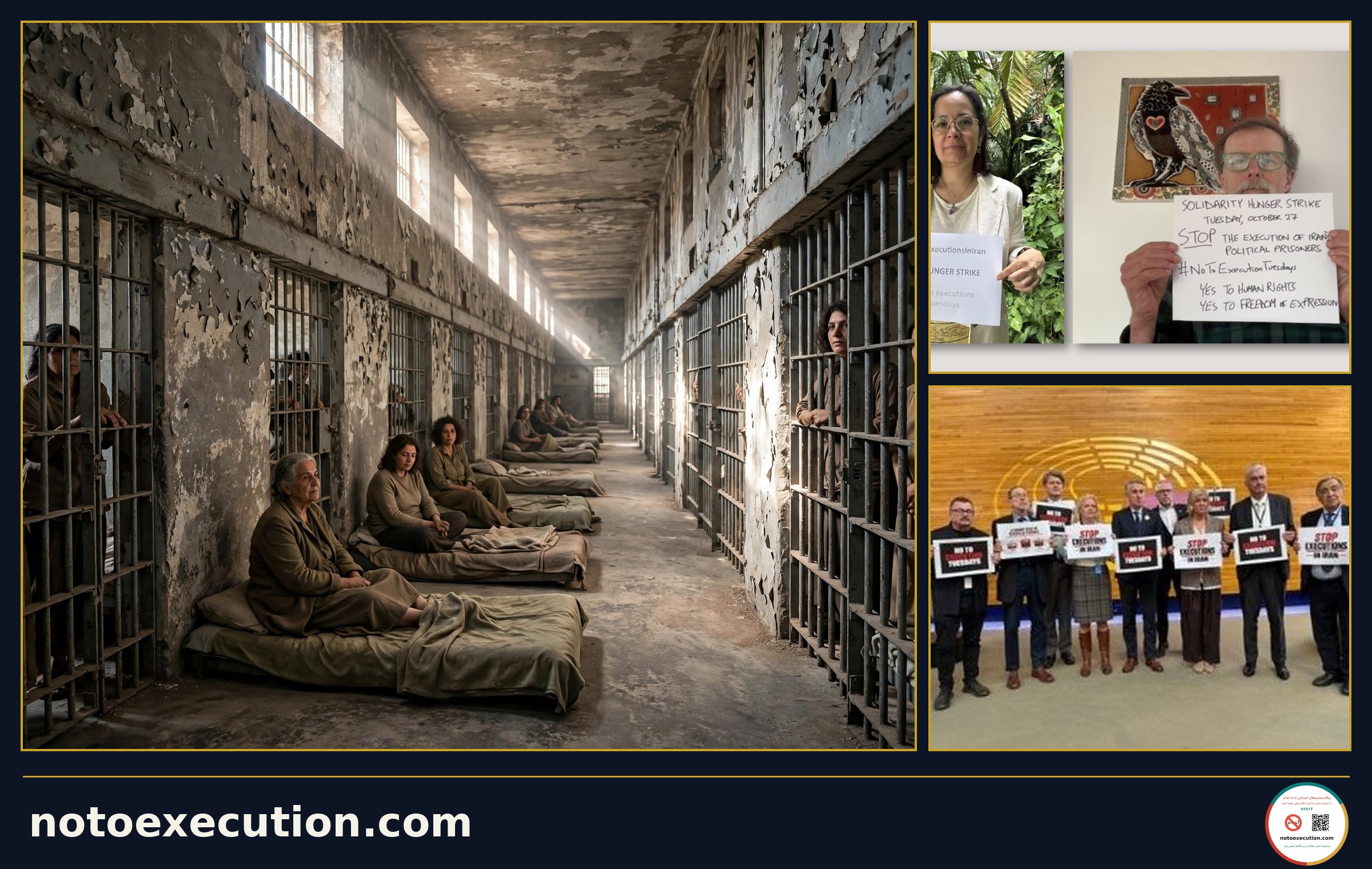
On Tuesday, 30 January 2024, a group of political prisoners in Ghezel Hesar Prison in Karaj did something rare in the history of Iran's struggle against the death penalty: a weekly hunger strike, every Tuesday, until executions are abolished. No one knew that day how far it would go. Today the strike has reached its 144th week, and prisoners in more than 66 prisons across Iran, every Tuesday, under the shadow of the gallows and at the risk of their own lives and health, refuse food and raise a single demand: no to execution.
But the greater event is this: the voice of these prisoners no longer remains behind prison walls. In recent weeks, United Nations special rapporteurs have one after another joined the hunger strike themselves; members of the European Parliament have held up "No to Execution Tuesdays" placards before the cameras; and Nobel Peace Prize laureates have declared their support for this campaign. This article reviews who they are, why they joined, in their own words, and why this prisoner-born campaign matters.
The United Nations: from naming the campaign to joining the hunger strike
Mai Sato, the UN Special Rapporteur on the situation of human rights in Iran, was among the first international officials to name this campaign. In her video message for the World Day Against the Death Penalty (10 October 2024), she said the "No to Execution Tuesdays" campaign, a prisoner-led initiative in which prisoners go on hunger strike every Tuesday against the death penalty, demonstrates the unwavering commitment to human rights and justice, and she urged the international community to amplify its call.
On 27 July 2026, a group of UN experts, including Mai Sato, Morris Tidball-Binz (Rapporteur on extrajudicial executions), Margaret Satterthwaite (Rapporteur on the independence of judges and lawyers), Gina Romero, Alice Jill Edwards (Rapporteur on torture), and the Working Groups on Enforced Disappearances and on Arbitrary Detention, named the campaign in an official statement published by the UN human rights office: prisoners are protesting peacefully through the ongoing "No to Executions Tuesdays" campaign, the experts wrote, urging the Iranian authorities to heed these calls and establish a moratorium on executions pending abolition.
October 2026 was the turning point: UN experts went beyond words and joined the hunger strike themselves, one after another, week after week.
Gina Romero, the UN Special Rapporteur on the rights to freedom of peaceful assembly and of association, began her 24-hour hunger strike in the campaign's 142nd week (13 October 2026). She explained why: "On Tuesday the 13th, I am joining the 'No Execution Tuesdays' hunger strike. The death penalty is being used against people for exercising their rights to freedom of assembly, association, and expression, as well as their political rights." She said she was joining prisoners who risk everything behind bars, adding: "I can help carry the heavy burden you bear every day." Romero called for an immediate halt to executions, the quashing of death sentences imposed after unfair trials, and independent monitoring of prisoners at risk. Mai Sato amplified her message, calling the step important.
Leopoldo Maldonado Gutiérrez, the UN Special Rapporteur on freedom of opinion and expression, began his 24-hour solidarity hunger strike in the 143rd week (20 October 2026): "I am joining a solidarity action with political prisoners in Iran participating in #NoToExecutionTuesdays. I stand with those facing persecution for their political opinions, expression and peaceful dissent, and reiterate my call for an immediate halt to executions." His warning was blunt: "We should not wait until the scale becomes catastrophic before acting."
Andrea Bolaños Vargas, the UN Special Rapporteur on human rights defenders, joined the solidarity hunger strike in the 144th week (27 October 2026): "I join #NoToExecutionTuesdays in the solidarity hunger strike for the human rights defenders that are being jailed and threatened with death for their work. At least 46 political prisoners and protesters have been executed in Iran since March 2026; more than 100 others remain on death row. The executions should end and those detained released."
David R. Boyd, former UN Special Rapporteur on human rights and the environment, also announced a 24-hour hunger strike in that same week, raising his placard: stop the execution of Iran's political prisoners; yes to human rights, yes to freedom of expression. And Ana Lorena Delgadillo Pérez, of the UN Working Group on Enforced or Involuntary Disappearances, has announced she will join the campaign next week, in solidarity with the victims of enforced disappearance and execution in Iran. The chain continues.
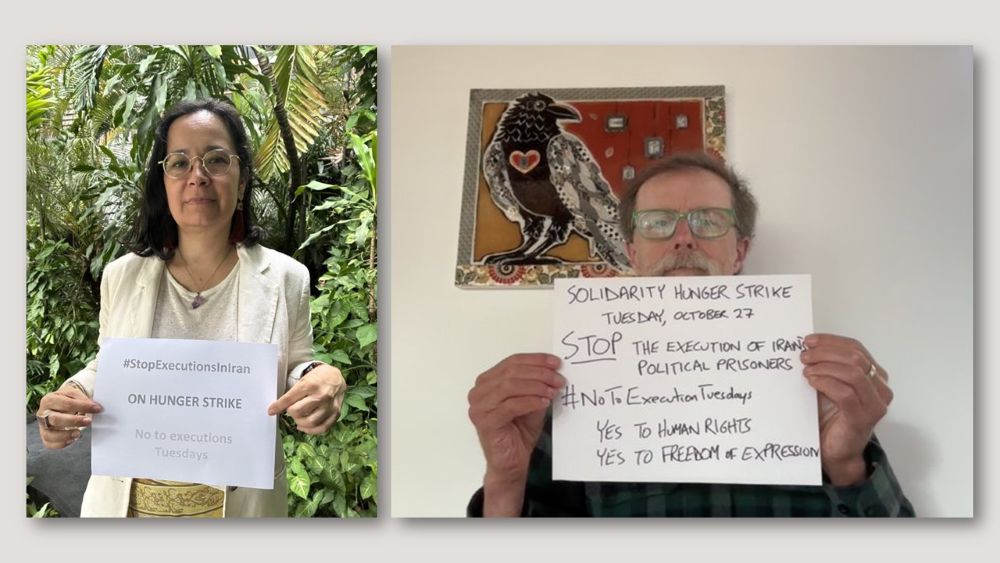
A former rapporteur and Nobel Peace laureates
Javaid Rehman, the former UN Special Rapporteur on Iran, declared his full support for the No to Execution Tuesdays campaign in a video message in September 2026, noting 136 weeks of hunger strikes across dozens of prisons: "Individuals must not be sentenced to death because of their political beliefs, organizational affiliations, or opposition to state suppression and violence." Rehman had earlier described the death penalty in Iran as a weapon used to terrorise the entire population.
Earlier, on 30 September 2024, nine Nobel Peace Prize laureates, Shirin Ebadi, Jody Williams, Leymah Gbowee, Oleksandra Matviichuk, Óscar Arias, Kailash Satyarthi, Tawakkol Karman, Rigoberta Menchú and Maria Ressa, declared in a joint statement: "We declare our support for the campaign against executions on Tuesdays and call for an end to this inhumane punishment in Iran." In October 2026, Matviichuk again amplified Maldonado's joining under the campaign's hashtag.
The European Parliament and national parliaments
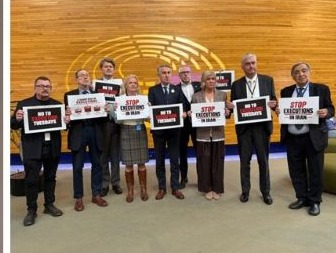
On 20 October 2026, in the campaign's 143rd week, a group of Members of the European Parliament held a solidarity event at the Parliament, holding up "No to Execution Tuesdays" and "Stop Executions in Iran" placards. Petras Auštrevičius of Lithuania, who spearheaded the initiative, wrote: "'No to Execution Tuesday' solidarity event at the European Parliament. We stand with people of Iran." Helmut Brandstätter of Austria, remembering Mahvash Sabet, the imprisoned Bahá'í, wrote: "Today, we joined the global campaign calling for an end to executions in Iran. We stand with all political prisoners in Iran fighting against executions." Milan Zver of Slovenia wrote: "Iranian prisoners risk their health every Tuesday with a hunger strike to draw attention to injustices and death sentences." And Per Clausen of Denmark declared his and his colleagues' solidarity and the demand for an immediate stop to the executions.
Dorien Rookmaker, a former Dutch MEP, announced her hunger strike on 13 October 2026: "Yes, today I am on hunger strike. Just like all the political prisoners in 66 prisons in Iran do every Tuesday. Worldwide, people are not eating in protest today. Join in." Former MEPs Struan Stevenson, Paulo Casaca and Tunne Kelam also joined the hunger strike in the same wave of solidarity.
Elisabetta Zamparutti, a former member of the Italian Parliament and a member of the Council of Europe's Committee for the Prevention of Torture, announced in August 2024 that she would hunger-strike every Tuesday alongside the prisoners, and renewed that solidarity at the conference marking the campaign's first anniversary. Herta Däubler-Gmelin, Germany's former Federal Minister of Justice, renewed her support at the same anniversary conference (January 2025) and demanded the immediate release of those sentenced to death. In Britain, Jim Shannon MP wrote: "I support the #NoToExecutionTuesdays campaign... Stand with them. End the executions," and Lord David Alton of the House of Lords backed Romero's joining. Earlier, in August 2024, 68 international human rights organisations had declared their solidarity and support for the No Death Penalty Tuesdays movement in Iran's prisons in a joint statement.
Why the protest Tuesdays matter
First, this campaign was started by the condemned themselves. Those waiting on death row turned from victims into actors, with the only weapon left to them: their own bodies. No one fought for them from outside; they raised the banner themselves and called on the world to help.
Second, its discipline and continuity: 144 consecutive Tuesdays, without interruption. That weekly rhythm turned the campaign into a standing appointment, one that anyone, anywhere in the world, can join, just as the UN rapporteurs joined it week after week. A scattered protest is forgotten; a weekly appointment builds an institution.
Third, the campaign has exposed what the death penalty in Iran really is: not the administration of justice, but an instrument of intimidation and political repression. When the UN's own Rapporteur on extrajudicial executions signs a statement that names this campaign, and when the European Parliament adopts its resolutions, the regime's official story, that execution is punishment for crime, cracks in the world's official records.
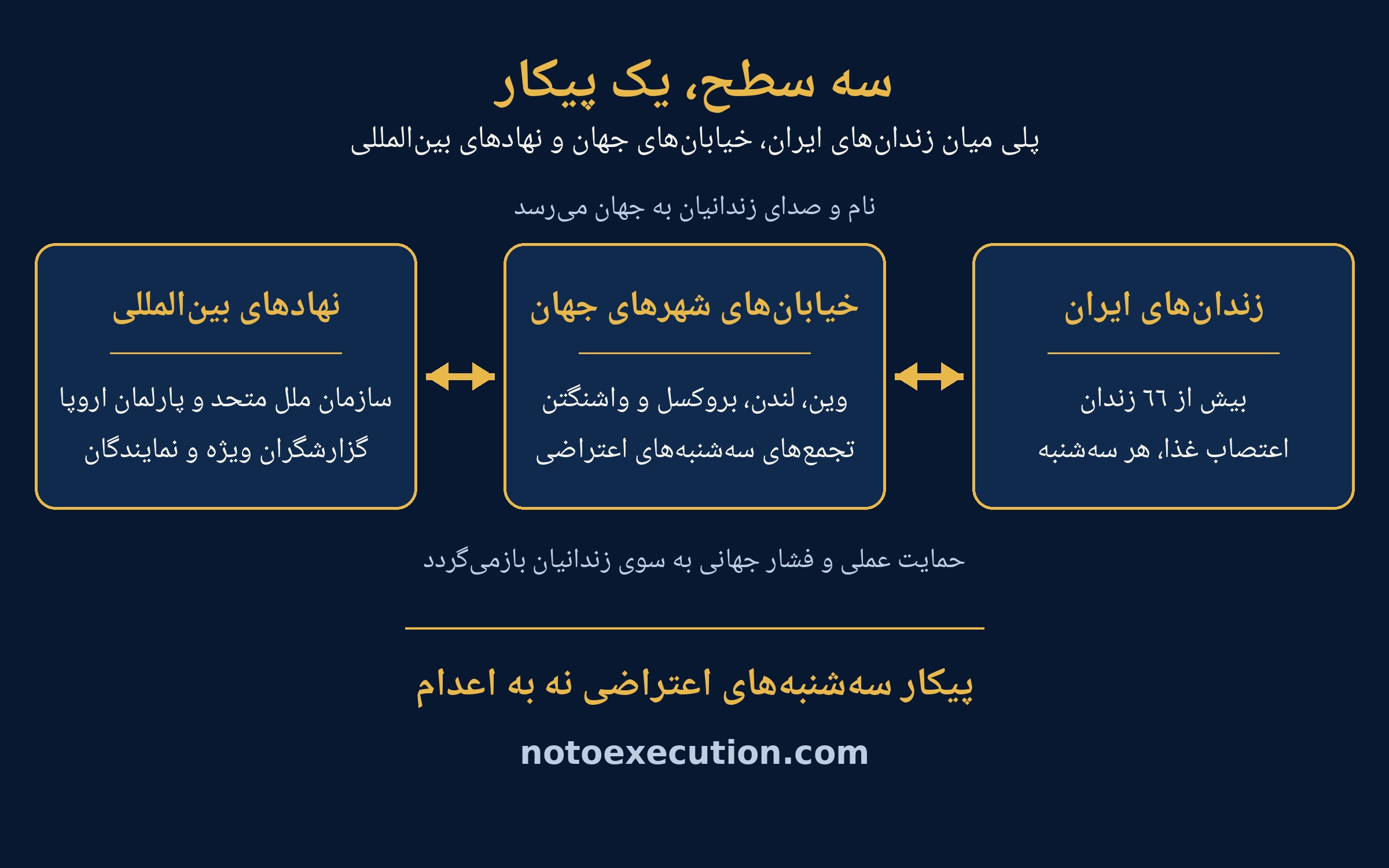
Fourth, the Tuesdays campaign has built a bridge between three levels: Iran's prisons, the streets of the world's cities, and international institutions. Names and stories of prisoners travel out across this bridge, and pressure and support travel back in along it. That is what deepens the regime's isolation and raises the price of every execution it carries out.
And fifth, this campaign defends the most fundamental right: the right to life, the right without which no other right has meaning. And it defends it peacefully; a hunger strike has no violence, but it breaks the silence.
From condemnation to practical action
One of the most important features of this wave of solidarity is its form. For years, the world's familiar pattern of response to the killing in Iran has been this: a statement is issued, the executions are condemned, "strongly condemned," and the file is closed until the next execution. The United Nations, with all its machinery, usually goes no further in the face of the world's tragedies: reports, resolutions, expressions of concern. But the hunger-striking prisoners have asked, again and again, for something else: practical support, not verbal sympathy.
What happened in October 2026 was precisely the answer to that demand. The UN special rapporteurs did not settle for issuing statements; they themselves went without food and stood beside the prisoners. The Members of the European Parliament did not only pass resolutions; they gathered and held up the No to Execution Tuesdays placards before the cameras. Romero spoke the names of the executed and of prisoners at risk of execution one by one; and that is exposure of the killing under way in Iran, with names and particulars, not generalities and condemnation from afar.
The importance of this step is exactly here: when an official whose duty is to defend human rights steps out from behind the desk and out of the statement format, and enters the field with their own body, their presence and their voice, support turns from words into action. Such action builds moral and political backing for the prisoners, raises the cost of continued executions for the regime, and sets a new standard before everyone: if a UN special rapporteur can hunger-strike, no one can say there is nothing they can do.
This experience is also a critique of the usual record of international institutions. Institutions often stop at resolutions without enforcement; but responsible people inside those very institutions showed that wherever there is will, the path of practical action is open. The Tuesdays No to Execution campaign demands precisely this: not spectators, but companions; not condemnation from afar, but presence alongside.
The invitation: now it is your turn
This movement took shape in more than 66 prisons in Iran and has now taken on a global dimension. The prisoners called out to the world from behind bars; freedom-loving Iranians in Vienna, London, Brussels and Washington answered that call and stand together in the streets of those cities every Tuesday. International figures too, from UN special rapporteurs to Members of the European Parliament and Nobel Peace Prize laureates, have joined this campaign and even taken up the hunger strike themselves.
But the prisoners' message is clear: condemnation is not enough; practical action is needed — the very action seen in October 2026, when UN rapporteurs went on hunger strike, Members of the European Parliament took up placards, and the names of the executed were spoken aloud. Now it is your turn to move from spectator to companion.
If you wish to join the Tuesdays No to Execution campaign: every Tuesday, supporters of this campaign gather in cities abroad — including Washington, London, Brussels and Vienna — and stand beside the prisoners. Join your city's Tuesday gathering; and if your city has none, contact us and we will build one together. A day of symbolic hunger strike, carrying the prisoners' voice to others, and standing in the street are all forms of that same practical action.
To join and coordinate, contact us through the campaign website and the campaign email:
Campaign email: [email protected]
The prisoners who, under the shadow of execution, have chosen hunger to defend life, ask for only one thing: not to be left alone. Join the Tuesdays No to Execution campaign.
Sources
Joint statement of UN experts, UN Human Rights Office (OHCHR), 27 July 2026
UN experts' statement urging a halt to executions in Iran (OHCHR), 9 October 2026